Thursday 29 October 2026, the second night
Nobody believes you at breakfast.
They watched the video three times last night. You reach for the switch, the kitchen goes dark for less than a second, the lights come back, and you are standing exactly where you were. Four hours, you keep saying. A girl, a fire, a red cross on the door. They are kind about it, which is worse.
But your hands smell of woodsmoke, there is black ash under your fingernails, and across your palm is a red mark the shape of a poker handle. And at seven this morning the host sent a message nobody can explain:
Thank you for keeping the fire. The house prefers it. P.
Nobody told the host anything.
In the afternoon somebody looks the house up. There is not much: a plague year, a family shut inside, and a later owner called Edmund Locke, who bought Sallowmere in 1912 to prove it was not haunted and wrote a pamphlet saying so. Then, after the war, he started holding séances in the library. Every Halloween. Every year.
Everybody goes quiet at that, and then everybody laughs, the way you laugh in a house like this.
Tonight nobody touches a light switch. Every lamp is on, the house hums around you, and for a long time nothing happens at all. Then, after the wine, somebody says it: the actual room, the actual week. You have to.
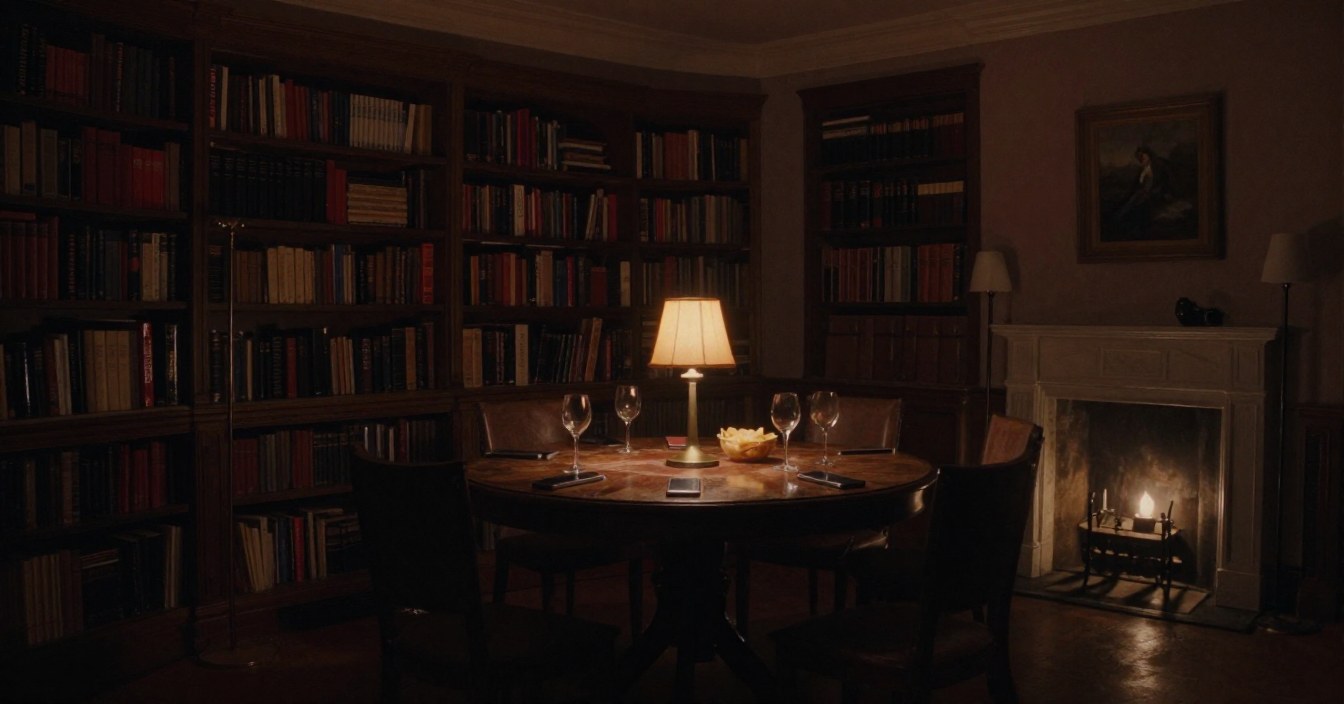
So you all sit round the old round table in the library with the lamps still burning, join hands, and take turns asking the dark whether anybody is there. Nobody is. It is funny for a while.
At five to midnight your phone buzzes. Nobody else's does.
Please do not ask the house questions tonight. It will answer. P.
Your friends see your face. And then, of course, they want you to ask.
"Go on," somebody says. "It likes you."
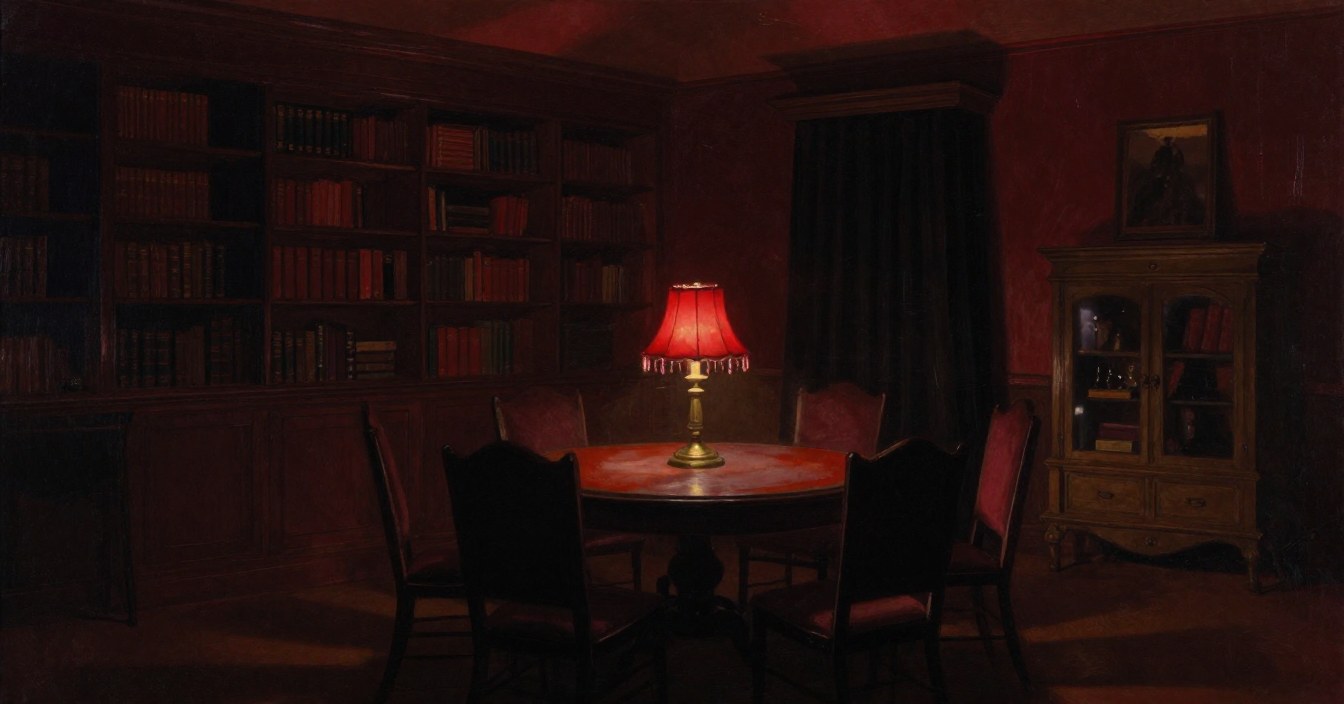
The library, Halloween night, 1922
The words are hardly out of your mouth when every light in the house goes out.
Not one at a time. All at once: the lamps, the hum, the glow of the phones on the table. And in the dark a woman's voice that is not one of your friends asks your question back to you, slowly: "Is there anybody there?"
The hand in your left hand is not your friend's. It is a man's hand, dry and old, and it is shaking.
A lamp comes up on the table, very dim, under a red silk shade, and you see the room. It is the library: the same round table, the same tall windows, the same fireplace with a fire burning low. But the walls are lined floor to ceiling with books, there is a black cabinet with curtains in the corner, and around the table, holding hands in the red light, are four people you have never seen.
Your friends are gone. Their chairs are other people's chairs.
It is the 31st of October, 1922. Four years ago the First World War ended, and more than seven hundred thousand British soldiers did not come home. Afterwards, thousands of families who could not bear it went to séances, where a medium claimed to let them speak to their dead. This is one of them.
The man holding your hand is Edmund Locke. He owns this house. Ten years ago nobody else would buy it, because the county still called it the plague house, so he bought it cheap to prove that ghosts were nonsense. Then the war took his only son. Kit was a signaller, a soldier who sent messages in Morse code, and he was killed in France four years ago tonight, eleven days before the war ended.
Kit's trunk came home with his things in it, and his last letter. Edmund has never been able to open it. He had the trunk carried down to the cellar, behind an old door that nobody can open, because its lock has no key. Since then, once a year, on this night, he sits at this table and asks for his son.
The woman with the red lamp is Mrs Marsh, a medium from London. In front of her is a candle marked in five places. When it burns down to the last mark, the séance is over until next year.
The big cheerful man with the moustache on your right is Sir Arthur Conan Doyle, who wrote Sherlock Holmes. He lost a son in the war too, and he believes in all of this completely.
In the red light nobody can see you properly. They think you are what Mrs Marsh just called up out of the dark. Edmund thinks you might be Kit.
You are not. But you know one thing nobody else in this house knows: where the key to that cellar door is. You hid it yourself, two hundred and fifty-seven years ago.
You have until the candle burns down to find Kit's last letter and put it in his father's hands.
Mark One: The Adventure of the Black Door
You let go of Edmund's hand, which nobody at a sitting is supposed to do, and Mrs Marsh says sharply that the circle is broken. Edmund says, very quietly, let it go. He follows you into the hall.
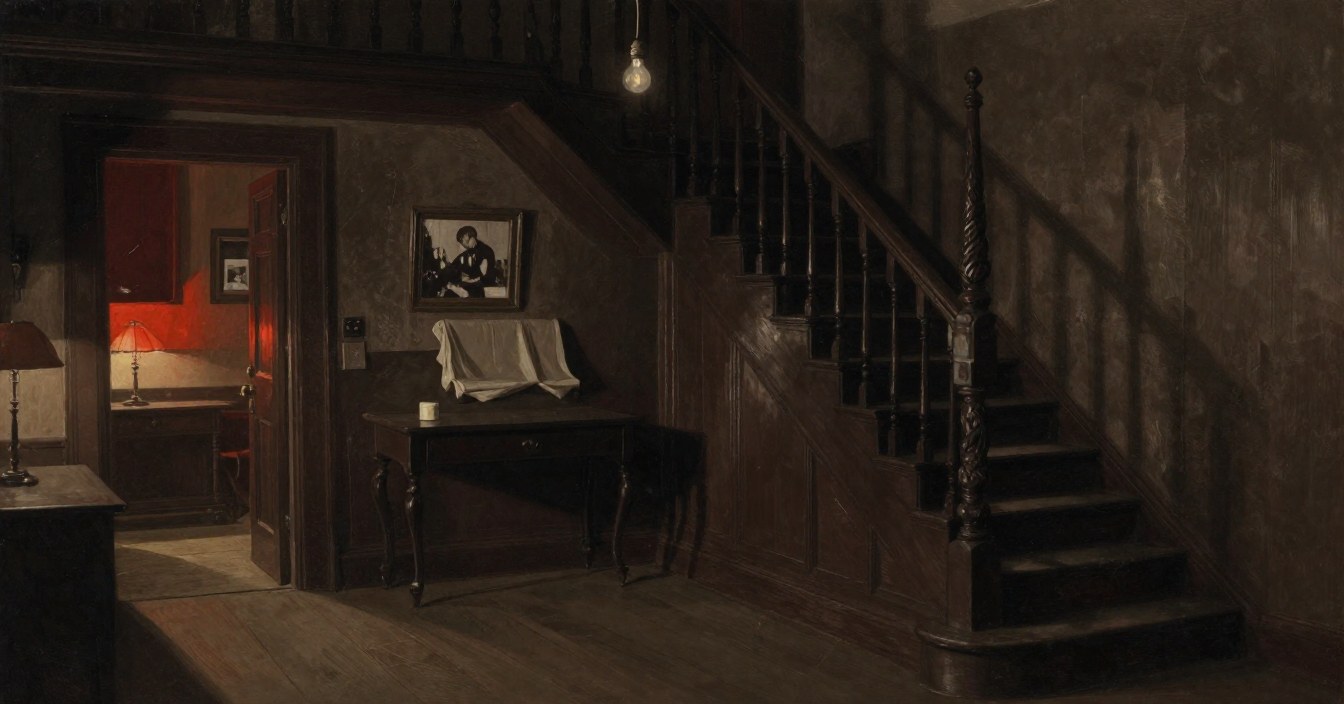
It is the same hall. The panelling is new and the stair has been mended, but it is the same stair, and the post at the foot of it still has letters carved round it, worn smooth by three centuries of hands.
At the far end of the hall, at the head of the cellar stair, is a door you have seen before: old oak, black with age, hung on new hinges. Edmund says his builders found it in the yard when they put in the new back door, and hung it here because it was too good to burn, lock and all. Nobody has ever had the key. Kit's trunk is behind it.
You know where the key is. You put it there yourself.
Sir Arthur has followed you out with the red lamp, breathing hard and delighted, and holds it up to the stair. Holmes, he says, would tell a man that he sees but does not observe. He seems to think the remark is for you.
Go to where you hid the key.
The hall in 1922. Tap the place where you hid the key.
Back to the table, with the key.
Somewhere in the house, very faintly, there is a knock: once, from the foot of the stair.